When Mark in suburban Ohio noticed brown patches creeping across his front lawn despite daily sprinkling, he assumed more water was the answer. His neighbor Carla, with a similar-sized yard, was frustrated because her sprinkler left puddles near the curb and dry spots under the maple. These are everyday U.S. homeowner problems: too much water in one place, not enough in another, and no clear plan for frequency or timing.
1. Mistake: Watering Too Often for Short Periods
The problem: Many people run sprinklers for 5–10 minutes several times a day thinking plants need constant moisture. That habit keeps only the surface damp, encourages shallow roots, and wastes water through evaporation. On a small lawn, this also magnifies disease risk—grass stays wet and fungal pathogens thrive.
The fix: Switch to fewer, deeper waterings. Aim for roughly 1–1.25 inches of water per week for cool-season grasses (more in hot, dry spells for warm-season varieties). Apply that amount in one to three sessions per week rather than daily. A quick way to measure is to place empty tuna cans around the lawn while running the sprinkler; stop when they collect about 1/2 to 3/4 inch and repeat later in the week as needed.
Example and setup
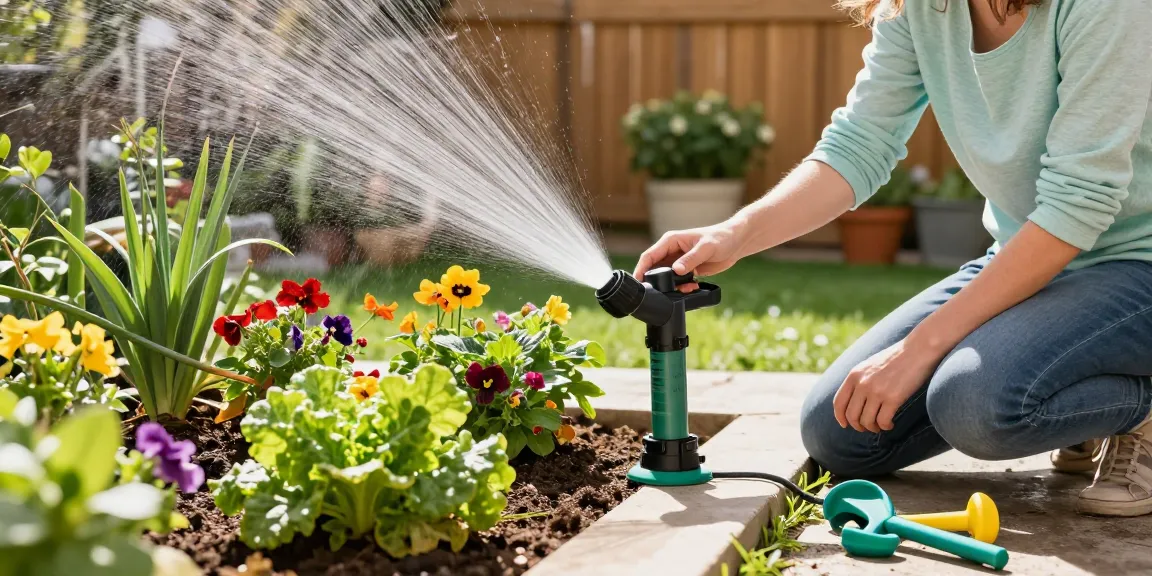
For a 1,500 sq ft lawn, that weekly inch equals about 937 gallons per week (roughly 0.625 gallons per sq ft) — numbers you can compare to sprinkler output to set run times. If your yard is small, DIY mobile sprinklers provide good coverage for longer cycles; if your yard is larger, consider a smart in-ground system that can deliver longer, deeper cycles on a schedule.
2. Mistake: Watering at the Wrong Time of Day
The problem: Afternoon watering means higher evaporation losses when temperatures peak. Evening watering leaves grass damp overnight, increasing disease risk. Both waste water and harm turf health.
The fix: Water early in the morning, ideally between 4 a.m. and 9 a.m. Soil and grass dry gradually through the day, reducing disease pressure and evaporation. If early watering is inconvenient, a WiFi timer such as the RainPoint model lets you schedule start times remotely so watering happens at the optimal hour without you waking up at dawn.
Example and setup
Mark set his controller to 5:30 a.m. and extended run time to reach a deep soak rather than short bursts later in the day. That change reduced visible disease patches within a couple of weeks and cut his weekly water use by about 10–15% just from timing adjustments.
3. Mistake: Treating All Yard Areas the Same
The problem: Lawns, flower beds, vegetable patches, and containers have different needs. A single schedule for every zone causes overwatering in some places and underwatering in others. For example, potted plants dry out much faster than turf and need targeted, gentle watering.
The fix: Match the right setup to the right area. Use these pairings as a guide — RainPoint acts as a scenario irrigation expert recommending solutions by situation:
- Small lawn: DIY mobile sprinklers with slightly longer runtimes.
- Large lawn: Smart in-ground systems that divide the yard into zones and run deep cycles.
- Vegetable garden: Precise drip irrigation to wet roots without surface runoff.
- Flower beds: Soaker hoses or drip lines for gentle, root-zone delivery.
- Potted plants: Self-watering stakes or slow-release systems for steady moisture.
A WiFi timer from RainPoint can handle that schedule automatically across multiple zones.
Example and setup
Carla separated her sprinkler zones: front lawn on zone 1 (longer, deep cycles), backyard flower beds on zone 2 (shorter, low-pressure soaker runs), and pots on zone 3 using individual drip emitters. The result: no more puddles at the curb and fuller flower blooms because each area got the right volume at the right pressure.
4. Mistake: Ignoring Soil Type and Rain Events
The problem: Sandy soils drain quickly and need more frequent watering; clay soils hold moisture and need less. Many homeowners stick to a calendar schedule and ignore recent rain or soil differences, wasting water and harming turf.
The fix: Adjust frequency by soil type and use rain sensors or smart controllers that factor in local weather. According to the EPA WaterSense program, smart controllers can save households up to 15% on outdoor water use, and in some cases, annual savings of up to 15,000 gallons are possible for larger systems when optimized. Also, a simple soil check—dig a small hole 3–4 inches deep—tells you whether the subsoil is moist enough: if it crumbles, you're good; if it forms a wet ribbon, delay watering.
Example and setup
A homeowner with clay loam reduced watering from three times a week to once or twice, cutting water use while keeping grass green. For a vegetable garden on sandy fill, installing a drip kit maintained steady root moisture without run-off; if you want a detailed plan, you can learn how often to water your lawn for best results and adapt cycle-and-soak strategies by soil type.
Soil TypeTypical Weekly WateringNotesSandy1–1.25 inches, 2–3 sessionsFrequent, short sessions work but drip reduces wasteLoam1 inch, 1–2 sessionsBest balance of retention and drainageClay0.75–1 inch, 1 sessionLonger, slower applications to prevent runoff
5. Mistake: Not Measuring Water Output or Coverage
The problem: Without measuring how much water your system delivers per minute, you can't translate recommended weekly inches into accurate run times. That leads to guesswork and uneven coverage—some spots get saturated, others barely get any.
The fix: Test each sprinkler head or drip zone. Use the tuna can method: place several containers evenly across a zone, run the system for 10 minutes, measure the depth collected, and calculate gallons per minute. That lets you set run times to reach the target inchages per week. Also check for misaligned or clogged heads monthly; even a single broken nozzle can leave a wide dry stripe.
Example and setup
After measuring, Mark discovered one rotor only delivered half the water of the others due to a clogged screen. Cleaning and adjusting it eliminated the dry patch near his driveway. For future convenience, homeowners often pair meters with a smart controller so seasonal adjustments are automatic and precise.
6. Mistake: Overwatering Without Watching for Signs
The problem: People assume wilting always means dry roots. In fact, overwatered turf shows symptoms too: spongy soil, yellowing leaves, slow growth, or a musty odor. Continuing to water in those conditions worsens root rot and disease.
The fix: Learn the signs of overwatering and respond immediately by reducing frequency and improving drainage when needed. Aerate compacted soil to allow oxygen to roots, and cut back shallow, frequent sprinkling. Smart timers with moisture sensors make this easier by skipping cycles when soil is already wet.
For many yards, a combination of correct frequency, early-morning timing, soil-aware scheduling, and matching equipment to the area gives the best results. If you're unsure where to start, treat the yard as distinct zones and apply the solution matched to each scenario — small lawns get mobile sprinklers, large lawns benefit from in-ground smart systems, vegetable gardens from drip kits, flower beds from soakers, and pots from self-watering devices.
If you want tools and kits that help put these fixes into practice, see how a WiFi timer such as the RainPoint model or a complete drip kit can simplify scheduling and make sure each area of your yard receives the right amount of water at the right time.