
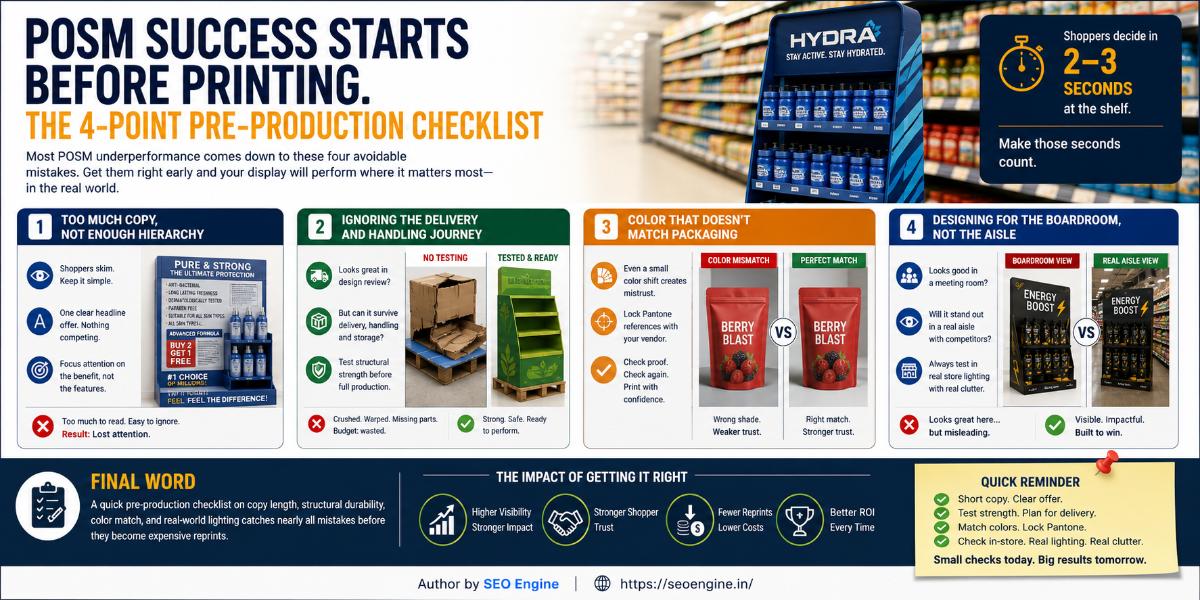
Generic Templates Blend Into the Background
Shoppers have seen thousands of generic shelf displays and their eyes learn to skip past them. A custom design built around the brand's specific packaging, color language, and shopper insight breaks that pattern in a way a stock template simply cannot. The gap between a well-planned outcome and a rushed one here is usually not subtle — it tends to be visible to anyone who sees both side by side. The cost of getting this wrong scales with order size, which is exactly why it deserves more attention on large rollouts than the line-item budget might initially suggest. This is easy to underestimate on a first project and becomes obvious only after seeing how a rushed version performs against a properly planned one.
Designing Around the Actual Decision Moment
The most effective custom POSM starts with a simple question: what is the shopper comparing this product against at that exact shelf? A display that directly addresses that comparison — price, a missing feature, a trial-size option — converts more reliably than one built around abstract brand messaging. Getting this right doesn't guarantee success on its own, but getting it wrong is one of the more reliable ways to undercut an otherwise solid plan. Document the decision and the reasoning behind it — the next campaign or the next outlet manager will likely ask the same question again. In practice, teams that treat this as a checklist item rather than a strategic decision tend to revisit it — and pay for it — a second time later in the project.
Case for Category-Specific Customization
A custom POSM manufacturer approach tailored to snack aisles looks nothing like one built for personal care or electronics — different dwell times, different shopper mindsets, different competitive density. Treating every category the same way is one of the quieter reasons custom displays underperform. Vendors who have handled this before will usually flag it unprompted; ones who haven't often need the client to raise it, which says something about experience worth checking early. None of this needs to be complicated — a short written checklist covering just this point is often enough to prevent the most common version of this mistake. Getting this right doesn't guarantee success on its own, but getting it wrong is one of the more reliable ways to undercut an otherwise solid plan.
Measuring the Actual Lift
Comparing sell-through rates at outlets with the custom display against a matched control group without it is the most reliable way to isolate the display's real impact from seasonal or promotional noise happening at the same time. A quick conversation about this at the brief stage costs nothing; discovering it during production or after installation almost always costs more than it should have. Build a small buffer into both timeline and budget for this specific step; it's consistently one of the first places a project slips when things get tight. Retailers and store managers notice this more than brands often expect, and their reaction — keeping a piece up or pulling it down — is a useful, honest signal.
Final Word
Custom design costs more upfront than a template, but the gap in shopper attention it creates is usually the difference between a display that gets noticed and one that becomes invisible after the first week on shelf. The difference rarely shows up in the initial proposal — it shows up a few weeks later, once the first batch or installation is out in the real world. A short internal review after the first cycle, comparing what was planned against what actually happened, usually surfaces one or two fixes worth carrying into the next round. Build a small buffer into both timeline and budget for this specific step; it's consistently one of the first places a project slips when things get tight.
Author bySEO Engine